- "Third Echelon's Multi-Vision Goggles are the state-of-the-art in enhanced vision technology."
- ― Sam Fisher describing his goggles in Tom Clancy's Splinter Cell: Chaos Theory.
Multi-Vision Goggles were experimental vision devices issued to all Third Echelon Splinter Cells for the purpose of being able to operate in multiple environments (mainly heavily shadowed or areas with low lighting) when deployed on a mission, mostly at night. They have two or more vision modes and were a signature part of a Splinter Cell's outfit, coming in two-lensed (in shades of blue, red or green) or three-lensed (in shades of green or blue) versions. The green, three-lensed version is Sam Fisher's iconic and most well-known goggles. In addition to being used by Third Echelon and Shadownet, they were also used by various groups such as ARGUS, Echelon, and UPSILON. Multi-Vision Goggles were succeeded by Ultra High-Frequency Sonar Goggles, after Fourth Echelon established, the Multi-Vision Goggles returns, known as Fourth Echelon Goggles, with Sonar capability added.
Functions
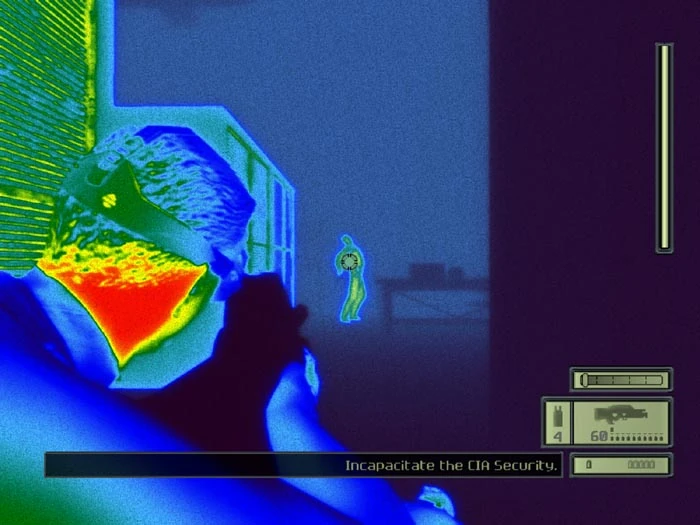

Sam using the goggles in thermal imaging mode.
The Multi-Vision Goggles, made of a highly-concentrated Plexiglass that are nearly impossible to shatter, are designed to allow Splinter Cells to maintain their vision in all potential environments while on a mission in a largely unknown sector. The most recent standard models ("tridents") allow for three different fields of vision: Night, Thermal Imaging/Infrared (IR), and Electromagnetic Field (EMF). With access to Multi-Vision Goggles, the operative is prepared to face the enemy in virtually any environment.
Night Vision
Night Vision grants operatives like Sam Fisher the ability to see in the dark in the absence of sufficient light, and also is crucial to their ability to operate in the shadows, away from enemy eyes. Night vision goggles work by amplifying the ambient light, particular emissions from the lower end of the infrared spectrum. Image intensifiers are used to amplify ambient light, allowing to see in extremely low light, but not useful in total darkness and causing temporary blindness if used in ambients flooded with light, therefore its not safe to use it when there is lightning during a thunderstorm, where Sam's view will be blinded for a short period. Some more advanced models featured infrared light emitters, invisible to human eye, which bounces off objects and is captured by special lenses that then convert it to a visible light spectrum. Those models allowed the user to see in completely dark ambients, and are often used by Third Echelon Splinter Cells. However, there are disadvantages that exist with night vision. If the operative wears night vision in the midst of any form of intense light, they will be blinded by the goggles, causing disorientation and rendering them susceptible to detection.
Thermal ("Heat") Vision
Thermal/Infrared Vision grants the operative the ability to detect human movements by identifying their body heat, which may prove especially useful in an environment where the air is thick with smoke or fog, or in areas of low temperature. The disadvantage of thermal vision is that it is useless in an environment where much of the area is dominated by high temperatures such as blazing fires or an area dominated by electrical equipment which obstruct a Splinter Cell's view of any enemies. But if you are in the area that Lightning will occur, thermal vision is the best tool to detect enemy guards or enemy equipment because the Nightvision goggles are not safe with lightning occurring.
Electromagnetic Field (EMF) Vision
Introduced in Tom Clancy's Splinter Cell: Chaos Theory, Electromagnetic Field (EMF, also known as "Wave") vision allows the player to see interference given off by electronic devices. Objects with functioning electronics (such as a power box, telephone, radio, security cameras, or a spy using his goggles or his gun) within the field of vision are picked up by EMF vision and displayed in white. This allows operatives to see any devices of importance and to take extra measures to avoid tripping enemy security measures. However, EMF vision also obscures any view of nearby enemies and the general area meaning that it must be applied only at the greatest necessity.
Electronically Enhanced Vision (EEV)
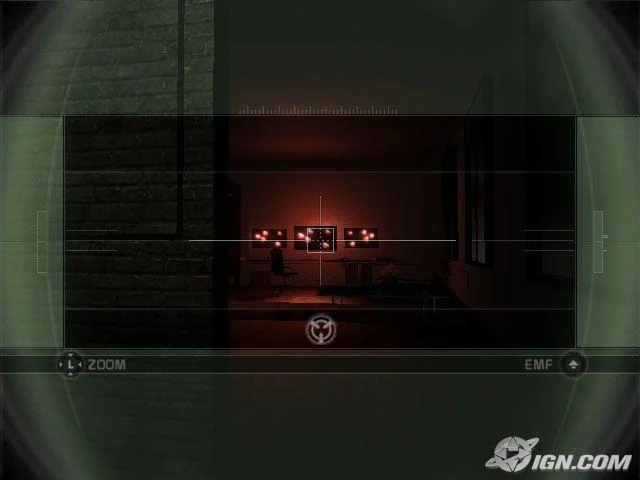
Sam in EEV mode.
Electronically Enhanced Vision (abbreviated as EEV) was a new and experimental device introduced in Chaos Theory which allowed Sam to scan an area and reveal different properties about the objects in that area. Interactive objects stand would stand out from the other objects while viewed in EEV, which can be used in conjunction with other modes.
Trivia
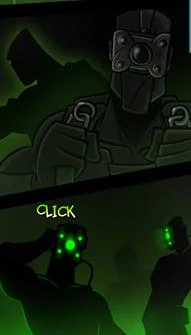

Multi-Vision Goggles turned on.
- The goggles have "Predator" on each side.
- The glowing trifocal goggles are considered one of the key trademarks of the Tom Clancy's Splinter Cell series.
- In the original Tom Clancy's Splinter Cell, Sam only had access to night vision at the start of the game. It wasn't until the "CIA HQ" mission when he had access to thermal ("heat") vision.
- The various modes are also referred to as "goggles", i.e. night vision goggles, thermal vision goggles (thermal vision headset), et cetera (as well as "modes") in the manuals and novels. Thus if Sam was to activate night vision, he is "turning on his night vision goggles". For the case of the ARGUS PMC helmet, the modes are referred to as EMF Vision and Motion Vision (a.k.a. Motion Tracking) in the manual.
- Multi-Vision Goggles appear to glow in cover art, artwork, and cutscenes from the games, novels, and comics, etc. (not only during gameplay). For example in Version 2 of Tom Clancy's Splinter Cell, Sam is shown diving in the Pacific, his goggles are "switched off" (appearing dark), as he gets deeper he turns them on and they appear to light up to a green glow [1]. The "switch on" glow is also shown in the Tom Clancy's Splinter Cell: Pandora Tomorrow comic book. In the comic, Shadownet spies goggles are turned on and physically appear to glow. In a cutscene for Double Agent (shown after Iceland level) Sam's goggles glow, and appear to lens flare when they get close to the camera, the glow also appears to diffract in the water, after Sam tosses them into the ocean.
- The night vision goggles in Hitman: Contracts bear resemblance to the icon Splinter Cell goggles.
- Despite the fact that goggles are usually portrayed as glowing, enemies cannot see the goggles. For example, in the Pandora Tomorrow Comic, although the goggles appear to glow the ARGUS mercenaries are oblivious to the Shadownet spies and only able to notice the spies after switching to other modes in their Multi-Vision Goggles such as Motion Tracking, EMF or the use of the built-in Torchlight. Likewise, their gear appears to "glow" as well, but they use the built-in torchlight on their Multi-Vision Goggles to see in the dark. The ARGUS gear changes color when switched between modes, orange when off, red for Motion and blue for EMF.
- Various enemies in the Tom Clancy's Splinter Cell games have used night/thermal vision goggles.
- The Georgian Elite all use NVGs.
- Guards in the Kola Cell use NVGs
- A Darah Dan Doa sniper in East Timor uses night vision goggles to guard the US Embassy in Dili, forcing Sam to walk in the light in order to sneak past the guard.
- Enemies in the Jakarta TFI TV station sometimes use NVGs.
- Norman Soth and his two personal bodyguards in the final area of LAX all use NVGs.
- Some Displace mercenaries in the Bathhouse level have TVGs.
- The I-SDF operatives in the Bathhouse land Kokubo Sosho levels use TVGs, allowing them to see Sam in the dark or through the smoke.
- In the darkened offices of JBA Headquarters, Carson Moss (Version 2)'s men are equipped with NVGs (Version 2 of Double Agent only).
- In Version 2 of Tom Clancy's Splinter Cell, Sam Fisher is shown using three-lensed goggles (with night vision mode) during the game's opening cinematic (which takes place just after Sam joining Third Echelon) while diving in the Pacific with his daughter, just before he meets 'Junior' Wilkes, who get him into contact with Lambert to brief him on his first mission with Third Echelon.
- In Tom Clancy's Splinter Cell (novel) Sam Fisher's goggles include night vision and thermal vision, as well as a special "fluorescent mode" which when turned on, allows him to see fingerprints and disturbances in the dust, allowing him to see if things have been moved (this may be based on the glow in artwork and games).
- The Multi-Vision Goggles used by Shadownet have different appearances. Some in Pandora Tomorrow are green and double-lensed, others have seen in Pandora Tomorrow and Chaos Theory have a green five lense, one large central lens surrounded by four smaller ones.
- The spies of Third Echelon and UPSILON in Double Agent (Microsoft Xbox/Sony PlayStation 2) multiplayer use night vision goggles. Third Echelon and UPSILON night vision goggles have a battery meter and only last for a limited time between uses (Xbox/PlayStation 2).
- UPSILON night vision goggles are yellow with two lenses.
- Third Echelon night vision goggles are blue with three lenses (and also red, yellow, green in Deathmatch mode).
- Shadownet and ARGUS Multi-Vision Goggles in Pandora Tomorrow and Chaos Theory have "Enhanced Reality" in addition to their other two modes. Which gives real-time updates of the location of a directive in all modes.
- ARGUS mercenaries had a helmet with Motion Vision and EMF Vision. They also have a built-in Torchlight mode for helping to see in the dark.
- UPSILON Force mercenaries do not have Multi-Vision Goggles in the same way that ARGUS had. They had a visor with a single EMF mode and other electronic display features such as automatic motion capture and proximity detector with audio based signals. The torchlight scope is on their gun rather than the visor.
- The Echelon Spies in Double Agent (Xbox 360/PlayStation 3/PC) have night vision and thermal vision.
- At the time of the novel version of Splinter Cell: Conviction, triple-lensed Multi-Vision Goggles a.k.a. "Tridents" had become standard equipment for all Splinter Cells. Tridents include three modes, night vision (NV), infrared (IR), and electromagnetic (EM)[1]
- Multi-Vision Goggles are replaced in Splinter Cell: Conviction with "Sonar Goggles" that features a single vision mode that sends out a sonic pulse which displays people and certain objects in bright white, even through walls, and displays everything else in shades of gray.
- The Multi-Vision Goggles return in Blacklist is better known as Fourth Echelon Goggles.
- In Splinter Cell: Blacklist, if the UAV operator is present, the Goggles will be disabled.
- In Splinter Cell 3D, Sam uses Multi-Vision Goggles with two modes, Fusion Vision and EEV. They can be used at the same time. Fusion is the primary mode.
- Tri-focal goggles can be seen on the 20th Anniversary Edition cover of Shadowrun, a science fantasy tabletop role-playing game.
Real life usage and function
In the first two games of the series, Fisher's goggles have both thermal imaging and night vision capabilities. In the first game, he starts out with just night vision but picks up thermal partway through. In reality, this would have required separate sets of goggles because of the complicated circuitry involved (technology has since advanced which allows thermal imaging and night vision modes in a single pair of goggles AN/PSQ-20). However, game developers decided to combine them into one device, as switching goggles would have made gameplay very cumbersome. In Pandora Tomorrow, the goggles also have limited zoom capability. Starting with Chaos Theory, the goggles have an integrated laser microphone and a third vision mode known as EMF Vision that highlights electromagnetic radiation emitted from nearby power lines, generators, and electrical equipment. Double Agent (Version 1) rewards players who complete side objectives with upgraded goggles that have "enhanced" night vision which shows the full-color spectrum, making it seem less obvious that the player is using the night vision (with the exception of some blurring when moving). Color night vision has become a reality.[2]
Multi-Vision Goggles are usually portrayed with glowing lenses in the games, cutscenes, comics and official artwork. In version 2 of Splinter Cell and the Pandora Tomorrow Comic the goggles are shown to be initially dark when worn, but appear to physically glow green when switched on [3]. Fans of the series regularly point out that they would give Fisher's (and other agents) positions away, however it was revealed in "The Real Sam Fisher blog" (Fisher's fictional web journal stating that he's merely the man the games are based on) that the goggles did not actually glow, and were simply portrayed that way on screen to provide visual interest and the location of the character in the dark. This is proven in the first multi-player outing of Pandora Tomorrow where ARGUS mercenaries viewing Shadownet devices similar to Fisher's will not notice any illumination. This is also shown in the Tom Clancy's Splinter Cell: Pandora Tomorrow (comic) which portrays Shadownet Spies and ARGUS mercenaries fighting (and ARGUS are completely unaware of the location of the spies without switching to other vision modes to see them).
If the player were to look at Sam's reflection in mirrors or reflective surfaces during single player mode in Chaos Theory, he or she would notice that the glowing of all aforementioned gear is nonexistent. Fisher's glowing goggles, radio, and OPSAT merely show the current location of his head, body, and arms respectively in the darkness for the benefit of the player.
In Tom Clancy's Splinter Cell (novel) Sam Fisher's goggles include a special "fluorescent mode" allowing him to see fingerprints and disturbances in the dust (this may be based on the glow in artwork and games). It this mode can be turned on and off depending on the circumstances, it is usually off.
It has never been explained what the function of the third lens in the center is for; however, it is possible that it is either an infrared emitter (providing light only the goggles can see) or is some sort of sensor for the EEV or the other vision modes. In Chaos Theory and Double Agent, his goggles have three modes at once (possibly a lens for each mode).
L3 Insight Technology produces a set of goggles known as the AN/PSQ-36 Fusion Goggle Enhanced that greatly resemble Sam's Multi-Vision Goggles and offer the user both night and thermal vision, but unlike Sam's goggles, the AN/PSQ-36 can also combine the two modes to varying degrees.
Gallery


References
- ↑ Tom Clancy's Splinter Cell: Conviction (novel), pages 96, 98